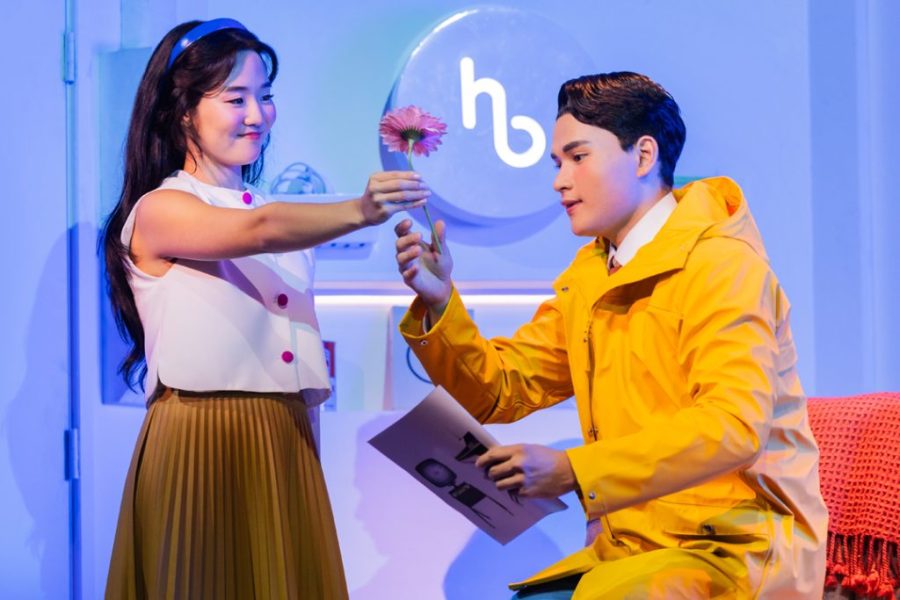
Claire Kwon and Steven Huynh in the North American Tour of “Maybe Happy Ending.” Photo by Evan Zimmerman for MurphyMade.
Baltimore’s exciting reputation as a pre-Broadway preview location is now also a launch for many national tours, including “Maybe Happy Ending,” (MHE) opening the 2026-2027 Broadway Series season at the Hippodrome. This critically-acclaimed musical, with lyrics by Hue Park and music by Will Aronson, was developed through various workshops beginning in 2014. Both Park and Aronson wrote the book, with Aronson writing the initial draft in English and Park translating it into Korean. The Korean version had a try-out engagement in Seoul in 2015, and both English and Korean versions were performed in industry workshops in New York in 2016. In 2017, the show won the Richard Rodgers Award from the American Academy of Arts and Letters and has also won 10 major Korean musical awards, including “Best Musical.” MHE had its English language debut at the Alliance Theatre in Atlanta in 2020 and opened on Broadway in 2024. It won six Tony Awards, including Best Musical, six Drama Desk Awards, two Drama League Awards, four Outer Critics Circle Awards, and the New York Drama Critics Circle Award for Best Musical. It has also been produced in Japan and China.
…experience the technical and acting wizardry of ‘Maybe Happy Ending.’
The setting is in the near future in the Seoul metropolitan area. The story involves the interaction between two obsolete, human-appearing helper-robots, Oliver (an older model) and Claire (a newer model), abandoned by their owners, who live in an apartment complex for retired helper-bots. A chance encounter leads to a unique friendship, although the “bots” differ in social ability and functions. Aronson has stated, “People have become sort of so attached to their technology… as people have become cynical about the world and isolated from each other, these first generation robots are discovering the world for the first time and discovering some of the things we’ve forgotten about.” One of those things is featured in the pre-show recorded song, “L-O-V-E,” performed by Nat “King” Cole.
Steven Huynh (Oliver) and Claire Kwon (Claire), both veterans of the Broadway production that is still running, are amazing in their roles. Their belt-style singing is powerful, their diction crisp and clear, and their acting is superb as they combine human with robotic movements under the care and skill of Broadway director Michael Arden. They interpret the beautiful and moving music and expressive lyrics to fit the emotions of each scene.
James Seol, playing both James and Junseo, is equally impressive as the father who abandons both his helper and his son. Francisco Javier Gonzalez portrays Gil Brentley, a 1930’s style jazz crooner, who comments in song on the action in several scenes. His movements and singing style are highly reminiscent of a young Frank Sinatra: his strong voice, sexy looks, jazzy interpretation, and appealing stage presence make his songs memorable. With no Broadway credits and just a few TV credits, this actor-singer has a stellar career ahead.
Audience members will not miss the appearance of a singing and dancing chorus, a usual feature of Broadway musicals. Besides the great sound of the seven-piece orchestra, conducted by music director Josh Tatsuo Cullen, your eyes are always directed to the stage by scenic designer Dane Laffrey and video projection designer George Reeve. Laffrey’s inspiration was 1970s Japanese metabolism architecture. The stage layout begins with two intimate, confined spaces representing tiny apartments. As the obsolete bots leave the agoraphobic comfort of their rooms to go on a road trip, the automated scenery slides away on massive turntables. The physical boundaries dissolve and expose a vast outdoor landscape. Reeve’s video design incorporates hundred of tiles mapped across the back wall, proscenium arch, ceiling, and floors. The team then used hologauze and media servers to project 3D holograms on to the stage. The actors then interact with the fully-realized 3D environment. The “Iris Aperture System” guides the audience perspective with an internal lens that allows the neon-lined mechanical irises to move in and out, pinching and swiping the imagery, mimicking a smartphone screen.
Several times during the final 15 minutes of the show, a scene ends and it seems the show is over. After a blank space, it continues. Laffrey explains that it reflects a changing world “reshaping around the characters. We really do think of it as a machine.” Discover your own inner android, get your tickets now, and experience the technical and acting wizardry of “Maybe Happy Ending.”
Running Time: One hour and 40 minute with no intermission.
Advisory: May not be appropriate for children under age 7.
“Maybe Happy Ending” runs through September 19, 2026, at the Hippodrome Theatre, The France-Merrick Performing Arts Center, 12 North Eutaw Street, Baltimore MD 21201. For more information and to purchase tickets, please visit the Box Office Monday-Friday, 11 am to 3 pm, performance days from 11 am to curtain, or go online.