There is a monster inside all of us. The choices we make and the people we touch determine whether or not it comes to the surface. Monsters aren’t born, they are a product of individual decisions. Emily Burns’ world premiere reimagining of “Frankenstein” at Shakespeare Theatre Company (STC) aptly unearths this moral conflict. Her elevation of these choices, coupled with the possible dangers of science gone too far, makes this story more engaging now than ever.
…engaging…What is obvious…is the excellence of STC’s production of ‘Frankenstein.’
Mary Shelley’s novel, Frankenstein, has rightfully become beloved literature in the modern canon. With that status comes many attempts at fresh adaptations, most notably the recent National Theatre production starring Benedict Cumberbatch and Jonny Lee Miller. A story with such wide connectivity allows each iteration to posit a new aspect of the piece. STC’s production sets itself apart by honing in on the flaws of humanity rather than the terror of a monster.
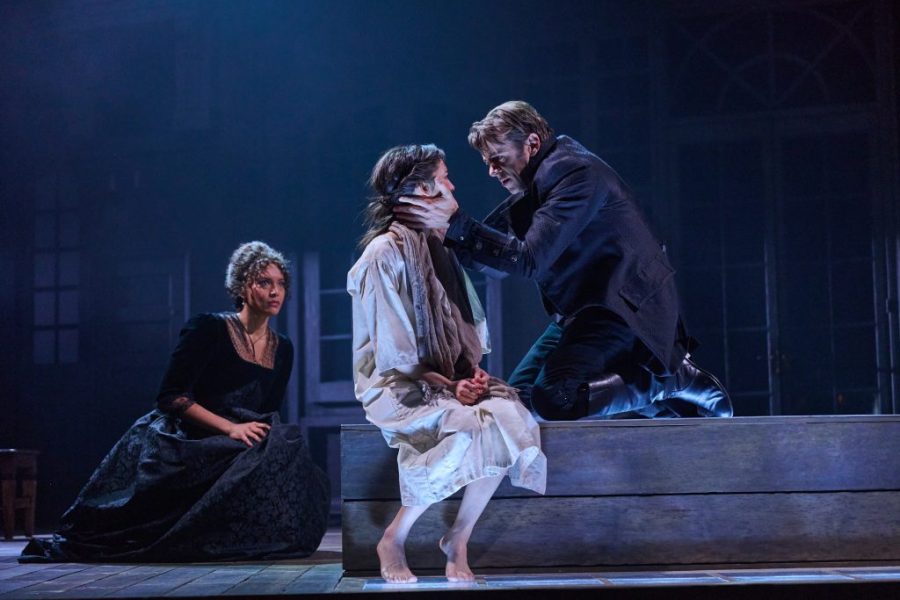
The play opens with the culmination of Victor’s (Nick Westrate) selfish need to do something important in his life—the birth of the Creature. Savvy lighting design by Neil Austin sets the tone for the unnerving play that leaves audiences waiting for the other shoe to drop, established by the normalcy of the first act. Stemming from childhood trauma, moral disagreements, and egotistical decisions, Elizabeth (Rebecca S’manga Frank) starts one of many fights with Victor the night before their wedding. Throughout the remainder of the show, human tragedy sets boundaries around this tale that waver with the supernatural elements.
Burns’ reimagined script targets the comparison between the natural creation of life and Victor’s other-worldly creation. This connection emphasizes the personal responsibility of the creator which is illustrated by a poignantly played altercation between the Frankensteins. Victor questions the responsibility he would feel if his theoretical child committed an abhorrent act. Yet, he fails to equate this moral stance to the realization of his own actions that cause tragedy. This is a small illustration of Burns’ talent to affix new meaning to this iconic novel.
Though, at times, the production leans into misplaced comedy, Burns’ direction is beautifully assisted by hair-raising, musical underscoring (André Pluess) that conveys unease. Lead performances are enhanced by the omnipresent creature’s (Lucas Iverson) disembodied voice, punctuating moments as the “monsters” inside both Victor and Elizabeth develop. Frank and Westrate unveil virtuoso dramatic chops in the final scenes, portraying the fine line between man and monster.
The creative aspects of this production further highlight Burns’ spotlight on so-called monsters. Kaye Voice’s thoughtful costume design and color choices lean into certain characters’ steps towards darkness. Andrew Boyce’s set seamlessly blends this idea beyond words by creating a singular setting encompassing all of the Frankensteins’ pain.
The true monster may not always be the most obvious choice. What is obvious, however, is the excellence of STC’s production of “Frankenstein.” It leaves audiences chilled to the bone—not because of traditional horror, but because of its exploration into the darkest aspects of the human soul.
Running Time: Approximately two hours and 20 minutes with one 15-minute intermission.
Advisory: Includes haze and fog effects, flashing and strobing lights, loud sounds, gunshots from a theatrical firearm, and disturbing themes, including psychological abuse, discussion of death, child loss and abandonment. Mild expletives.
“Frankenstein” has been EXTENDED through June 29, 2025 at Shakespeare Theatre Company’s Klein Theatre, 450 7th Street NW, Washington, DC 20004. For more information and to purchase tickets, call the Box Office at 202.547.1122 or go online.