


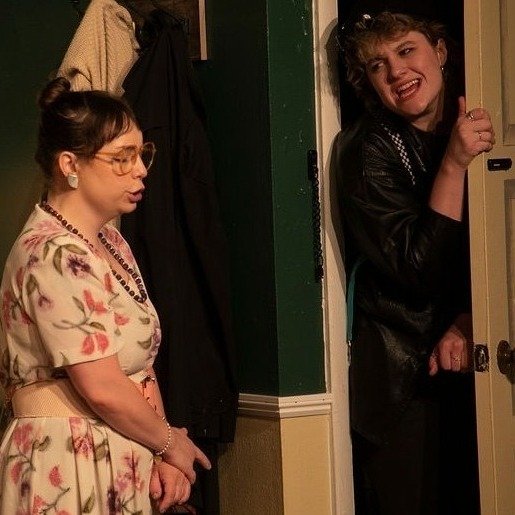
Caitlyn Weaver and Will Murphy. Photo by Shealyn Jae.
There’s just something about Irish playwrights, especially the current generation. In 2017, Baltimore audiences saw the American premiere of “Voices in the Rubble” by Darren Donahue at Rapid Lemon Productions. Now, Strand Theater is home to another stateside debut in Meghan Tyler’s “Crocodile Fever.” The remarkable play was first produced as part of the Made in Scotland 2019 showcase. One review described it “like Tarantino for feminists,” and that isn’t far off. The play certainly includes more than its share of violence and gore, but that’s only part of the story. At its center, this is an absurdist story about a classic, dysfunctional family.
Tyler’s script pulverizes expectations…Tessara Morgan Farley’s direction is tight as a drum… great writing, direction, and acting between Murphy and Weaver.
It’s the summer of 1989. South Armagh is a republican stronghold in Northern Ireland, and a key area of tension during the height of “The Troubles.” There we meet members of the Devlin family. Alannah (Caitlyn Weaver) presents as dutiful and fastidious, keeping her household ship-shape for her invalid father Peter (Frank Mancino). Fianna (Will Murphy) is another daughter who invades the space after an 11-year absence. Most of the first act consists of the sisters’ reunion. It’s full of tension, resentment, and revelations about a sordid past. It’s also extremely funny. Rather than a Tarantino comparison, one is tempted to look at Suzan-Lori Parks’ catalog. “Fever” is similar, only much weirder and much, much funnier.
Alannah is the archetypal “good sister.” Devoutly Catholic, she opens the play with a lonely, angst-ridden dumbshow that is brilliantly executed and shows us exactly who this woman is. When “bad sister” Fianna storms in, all kinds of personal hell break loose between the two. Their father is offstage for this, though the character looms large. It is in this crucial first act that Strand’s production shines brightest. Tyler’s script pulverizes expectations, even when it colors (mostly) within the lines of family drama. Tessara Morgan Farley’s direction is tight as a drum and shows a freewheeling touch that belies its unrelenting pace. Most impressive, perhaps, are the performances by Weaver and Murphy. These actors are SO great together that it’s hard to believe they haven’t worked with each other many times before. Imagine Jack Lemmon’s Felix Unger paired with pretty much any one of Mickey Rourke’s roles from the 1980s. Then pretend that those cis male types never existed until after this play’s blueprint showed them how to do it. There you’ll find a glimmer of what these amazing performers create as a team. There’s also the father and an English soldier (Pablo Akira Richter) who appears late in the second act, but “Fever” is more or less a two-hander. Strand’s production benefits from great writing, direction, and acting between Murphy and Weaver. Each time Alanna says “I need to do things a certain way,” Weaver shows her character’s descent from confidence to pitiable pathology. This sensation of sinking is a marvelous setup for Alanna’s reclamation, and we discover Alanna is capable of sarcasm (and of far more than that).
There’s a hilarious bit of singalong featuring Alanna’s explanation of her misunderstood version of lyrics to “Africa” by Toto. “I guess it rains on an apricot,” she says, in the voice of a reluctant patriot who’s been sent into space for a battle against “a hundred men on Mars.” Weaver’s telling of this ridiculous tale is so earnest that there’s a sudden rush of wistful energy the moment one is able to stop laughing.
In the “bad sister” role, Murphy is far more than just a rough-and-tumble troublemaker. Tyler gives Fianna plenty of juicy material here, though it doesn’t quite feel as three-dimensional overall as Alanna’s. Murphy makes up for this by adding physicality which broadens his character’s limitations. Every pose, every glance, every take by Murphy feels perfect and honest. There are countless moments in Murphy’s delivery here that amount to comic gold, and they form a substantial part of the bedrock between the actors. This foundation is tested at the shocking end of the first act and throughout the second as Tyler’s story spirals out of orbit.
The play’s title alludes to a legend about the Asmat tribe of New Guinea. Beset with crocodile attacks, they formed a belief that the animals were reincarnated versions of evil humans. The only way to defeat the evil was to kill and eat the crocodiles. Thanks to Mika J. Nakano’s impressive puppet design, the legend is brought to life in the tumultuous second act. Nakano gets a great assist from Jaeden Arrington’s lighting design which provides more than just mood washes. There’s a gorgeous, military searchlight effect which accompanies helicopter sounds by Mark Navarro and Mike Vacek. These designers are quite busy, and the work is first rate. Navarro created the soundtrack to last year’s dazzling “Lyra and the Ferocious Beast” by Truepenny Collective, and his evocative style is evident here. Liz Dunlap’s costumes echo the realism of her work on Vagabonds’ “How I Learned to Drive,” and Gerrad Alex Taylor pulls double-duty as fight choreographer and dialect coach. Taylor’s work in both areas add honest authenticity to the production. We’ve witnessed the unfortunate distraction of poor dialect work on stage before, and it’s a relief to report that the brogues on offer here sound great. Not only do they play realistically, the performers don’t betray the effort required to maintain them.
Running Time: Approximately two hours with one intermission.
Advisory: Contains strong language, references to domestic and sexual abuse, graphic violence, flashing lights, use of imitation theatrical firearms, sounds of firearms and explosives, fake blood and gore in abundance, smoke from fake cigarettes and tobacco, simulated excessive drinking of alcohol. Not suitable for patrons younger than 13 years old.
“Crocodile Fever” runs through June 30, 2024 at Strand Theater Company, 5426 Harford Road, Baltimore, MD 21214. For more information and to purchase tickets, go online.



