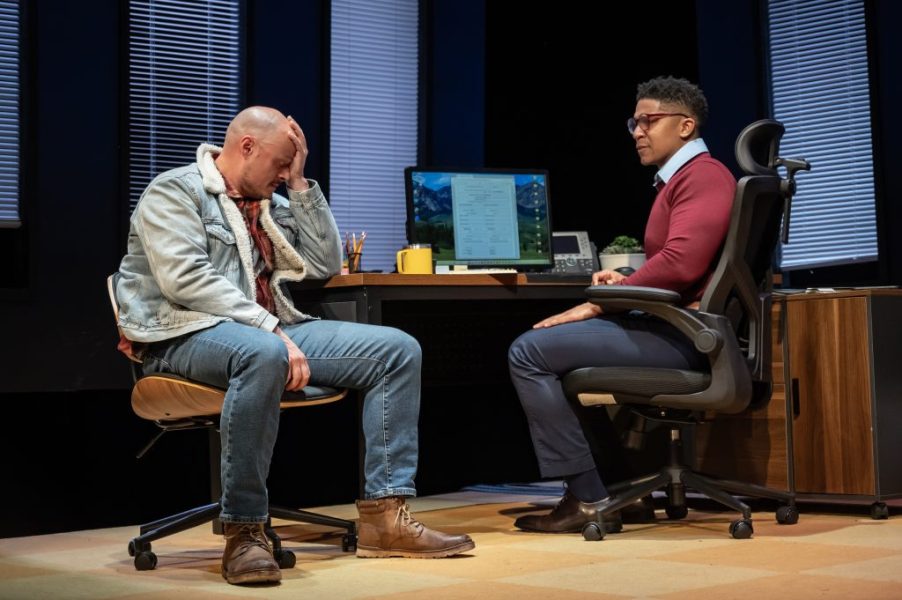
Lee Osorio as Ryan and Jaysen Wright as Keith. Photo by Chris Banks.
Samuel D. Hunter is a playwright rapidly on the way to becoming an iconic voice of the blue collar, the downtrodden, and the frequently forgotten. Often based in Idaho (from where Hunter hails), Hunter’s plays tend to position the world from the perspective of one who desperately holds onto hope despite the ostensible hopelessness of a given situation—and so it goes with “A Case for the Existence of God.” Mosaic Theater Company presents this compelling, harshly lonely at times, and deeply engrossing play about what it means to find true friendship amid some of the most difficult challenges that life can throw at you.
…compelling, harshly lonely at times, and deeply engrossing play…The cast…is exceptional…Highly recommended.
Ryan needs a mortgage. He wants to purchase 12 acres of peace and serenity (adjacent to a new housing development) so that he can build a better life for himself and his daughter. Not to mention that once upon a time, the land was owned by Ryan’s great-grandparents. Their legacy, however, is not exactly history-book worthy, though Ryan is on an endless search to find anything from his family’s past worth holding onto. Keith is the mortgage broker to whom Ryan turns in his quest to “make something good” for his kid. Grappling with his own trials, Keith is in the process of adopting a little girl whom he’s been fostering for over a year. His status as a gay man in Twin Falls, Idaho does not bode well for his case. Two men dealing with two very different and, at the same time, emotionally aligned problems sets the stage for an unlikely friendship that will prove both divisive and healing.
Hunter gives us an especially riveting two-hander that reads as a psychological study in life-changing male friendships. Much has been made of late about men’s mental health, the issues associated with the “manosphere,” and the reticence that men sometimes have expressing emotional vulnerability. Hunter’s play explores what it means to connect on a deeper level when you are otherwise drowning in a sea of solitude. Ultimately, Ryan and Keith unapologetically break the barriers that seemingly make “men, men.” Money problems, marital woes, and the heartbreak of parenting prove suffocating. Reaching out, they discover a much-needed lifeline in an unexpected place.
Director Danilo Gambini perfectly understands how to navigate the emotional maelstrom that Hunter configures here. Gambini masterfully builds tension and then lets it explode in the most satisfying and surprising way possible. Needless to say, I am a fan of his directorial work. The cast Gambini has to work with is exceptional. Lee Osorio as Ryan and Jaysen Wright as Keith hold absolutely nothing back. The spontaneity of their reactions and the depth of their emotional highs and lows make this friendship—and this play— extraordinarily powerful. In one rather complex and tumultuous scene, Wright’s character comes completely undone as audience members held their collective breath, waiting for the spiral to stop. Wright’s portrayal is subdued throughout which makes this flawlessly executed moment one to remember. Osorio takes us on a journey that is both enlightened and self-defeating inasmuch as he is the “everyday guy” without a cause, a factory worker whose hamster wheel life proves agonizingly unbearable at times. He’s simply looking for a way out—a way into that picturesque, wooded world where he can give his daughter a better childhood than he had.
Set design by Nadir Bey offers an intriguing blend of sterile office space with more abstract touches of whimsy. We are to imagine Keith’s office as multiple locations. For the most part, this strategy works as the actors do a commendable job of setting the scene given the emotionality and thoughtfulness they infuse into Hunter’s script. Though, admittedly, I would’ve liked to have seen a bit more done in terms of perhaps a multidimensional intention with the set. Lighting by Colin K. Bills provides vibrant, color-coded cues that help transfigure moments and scenes, and Sarah O’Halloran’s sound design adds depth to the otherwise quiet intensity of this play.
“A Case for the Existence of God” explores how the fragility of a certain kind of friendship can also be an eventual source of strength for that friendship. It is a deeply meaningful contemplation on how we live, who we live for, and what it all means in the end. Highly recommended.
Running Time: One hour and 40 minutes with no intermission.
“A Case for the Existence of God” runs through December 14, 2025 presented by Mosaic Theater Company at Atlas Performing Arts Center, 1333 H St NE, Washington, DC 20002. For more information and to purchase tickets, please go online.