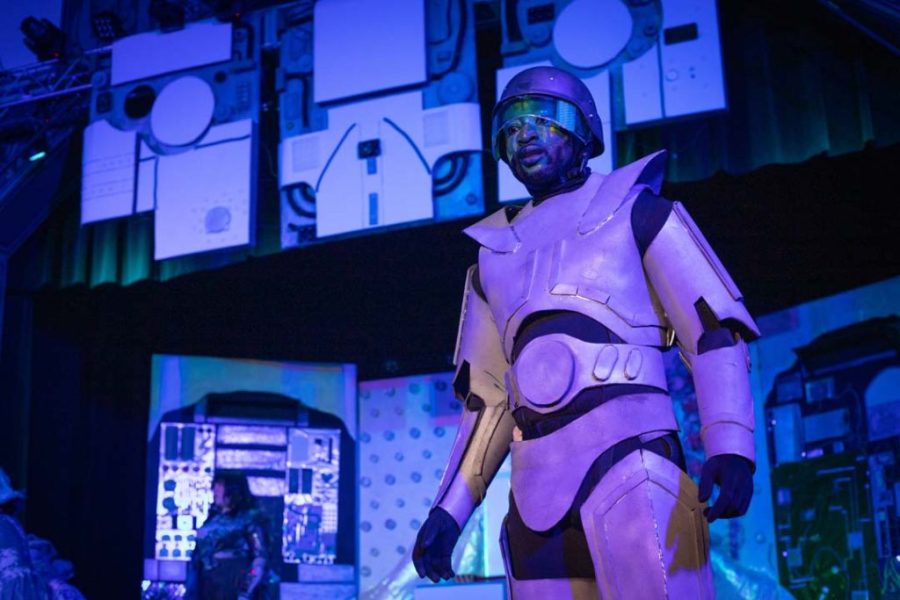
Michael Changwe as Charlie, the computer that loves. Photo by Heather Keating.
Rock operas really are their own special breed of show, comprised of vivid costumes, powerful, edgy songs, and very often a heavy dose of fantasy and adventure. The Baltimore Rock Opera Society (otherwise known by their acronym B.R.O.S.) presents an odyssey that takes audiences from the 1960s to a future in which the end of the universe is terrifyingly imminent. All because of a computer.
…soulfully translates human emotion into well-written and delightfully performed song and dance numbers. The songs steal the show.
“A Computer that Loves: And Why Not To Build One,” written by Gabe Shatkin, Jamie Ginsberg, and Liz ‘Nic Cole’ Unaeze with music by Gabe Shatkin, is billed as a science fiction, tragicomedy rock opera. It certainly lives up to this billing. Capitalizing on a highly popular trope right now, the show attempts to depict what might happen should a computer grow so big, so powerful that it develops the capacity and emotional intelligence to take over the world, or in this case, “assimilate” the humans with whom it comes into contact. Ultimately, as is the case with most dystopian plots, everyone (or most everyone) is indeed cast under whatever spell the computer is using to manipulate humankind, and quite early on, the writing is on the wall.
Created in the mid 1960s by Suzy Baker (Lily Wilson in a memorable performance), Charlie, a.k.a. The Computer (an endearing and still menacing Michael Changwe), initially has altruistic intentions—also a fairly common plot point in these “AI takes over the world in an attempt to make it better” stories. He wants to rid society of war, prejudice, hunger, pollution, and the entire litany of ills that plague the planet. Charlie’s efforts to rectify the errors of humanity however spiral into chaos and tragedy.
Longing to get out of Suzy’s lab—especially after Suzy is gone—Charlie finds his unwitting savior in the form of Gavin (Pablo Akira Richter). Gavin is the perfect embodiment of the selfishness and greed that Charlie sees as inherent to human beings, as Gavin plots to use Charlie to make millions. Charlie eventually escapes and embarks on his own destructive path of world domination, though that’s not necessarily his intent.
The storyline can be confusing at times. The constant presence, for example, of a character called Frund (an appropriately droll and highly entertaining Valerie Holt) who possesses a left hand with its own agenda is difficult to decipher. The music in conjunction with some very helpful projections enable you to at least trace the course of the narrative. Time gets tricky in this rock opera as characters move from the 60s into a desolate future populated by people who look and act exactly like they just came through some sort of robot apocalypse. Led by the “Captain of Narf” (Ellen Manuel’s performance in all of the roles she plays is arguably the most notable), the survivors serve both a comedic function and help usher Suzy from one segment to the next.
There are also singing rats, blue-hatted dancing ladies, and rather bizarre 1950s-style clips of rodents and robots. The show packs a lot in to make the point that AI unfettered can be a very bad thing. Directors Aran Keating and Debra Lenik have a plethora of moving parts to make work together like a, well, machine, and they pull it off.
B.R.O.S. offers up a rock opera that blurs the line between the trend toward machine-dominated dystopias and musical production that soulfully translates human emotion into well-written and delightfully performed song and dance numbers. The songs steal the show. Among my favorites, “Congratulations, You’ve Been Assimilated,” the rat pack-spotlight number “Scribbles,” and the heartfelt, albeit slightly misplaced, finale “Maybe.” The band, under musical director Gabe Shatkin, appropriately rocks, though at times they do overpower the singing. The set design by Kairo Cooper and Kelaysha Williams isn’t afraid to have fun with itself—this is a sci-fi, tragicomic rock opera after all. Production designer Mace Mehring obviously had a vision and the team, including props designer Tracey Townsend, creatures designer Chris Reuther, costume designer Dane Hansen, lighting designer Chris Allen, and audio technician Nathaniel Nelson among others, vibrantly bring that vision to life.
Running Time: Two hours and 30 minutes with one intermission.
“A Computer That Loves: And Why Not To Build One” runs through June 1, 2024, presented by The Baltimore Rock Opera Society, Zion Church, 400 E. Lexington Street, Baltimore, MD 21202. For more information and to purchase tickets, go online.